


In Part 1, we followed molecules picking up and releasing H⁺. We saw how those exchanges settle at a balance, how the tiny amount of H⁺ left free gives us the pH, and how Henderson–Hasselbalch describes the relationship between H⁺, bicarbonate and CO₂. But we left a question unanswered.
How can changing sodium, chloride or albumin alter pH when none of them is simply donating H⁺?
Put the blood-gas report aside for a moment. Imagine the blood itself: water containing charged ions, bicarbonate, CO₂ and proteins able to bind and release H⁺.
We need to understand what happens among those substances before deciding which factors are dependent or independent.
Some ions keep their charge; buffers can change theirs
Start with ordinary sodium chloride. When it dissolves:
NaCl → Na⁺ + Cl⁻
Sodium carries positive charge. Chloride carries negative charge. Across the pH range encountered in blood, they remain essentially in those forms. Their concentrations can change because we add them, remove them, dilute them or move them between compartments, but they do not meaningfully bind or release H⁺ to change their charge state.
These are what Stewart calls strong ions.
“Strong” does not mean powerful. It means that, at physiological pH, they are essentially completely dissociated.
There is a slightly confusing bit of terminology here. The opposite of a strong ion is not a “weak ion”. The useful contrast is with a weak-acid or weak-base system, whose charge changes as H⁺ is released or bound.
Now return to our simple buffer from Part 1:
HA ⇌ H⁺ + A⁻
A⁻ carries negative charge. If it binds H⁺:
A⁻ + H⁺ → HA
that negative charge disappears. The H⁺ has not vanished; it is now attached to the buffer. If HA releases H⁺ again:
HA → H⁺ + A⁻
the negative charge returns.
So unlike chloride, the amount of negative charge carried by this buffer changes according to how much H⁺ it has bound.
Albumin behaves in this way. It is not literally one HA molecule; it is a large protein containing many groups that can pick up and release H⁺. As more H⁺ binds, albumin becomes less negatively charged. As H⁺ is released, it becomes more negatively charged. Phosphate behaves similarly. Bicarbonate belongs to the CO₂ buffer system we already know:
H⁺ + HCO₃⁻ ⇌ H₂CO₃ ⇌ CO₂ + H₂O
Lactate deserves one clarification. Lactic acid is chemically a weak acid, but at blood pH almost all of it is already present as lactate⁻. Within the physiological range it therefore behaves as a strong anion in Stewart’s accounting. The first distinction is therefore quite simple:
Strong ions retain their charge.
Buffers can change their charge by binding or releasing H⁺.
Where is the rest of the charge?
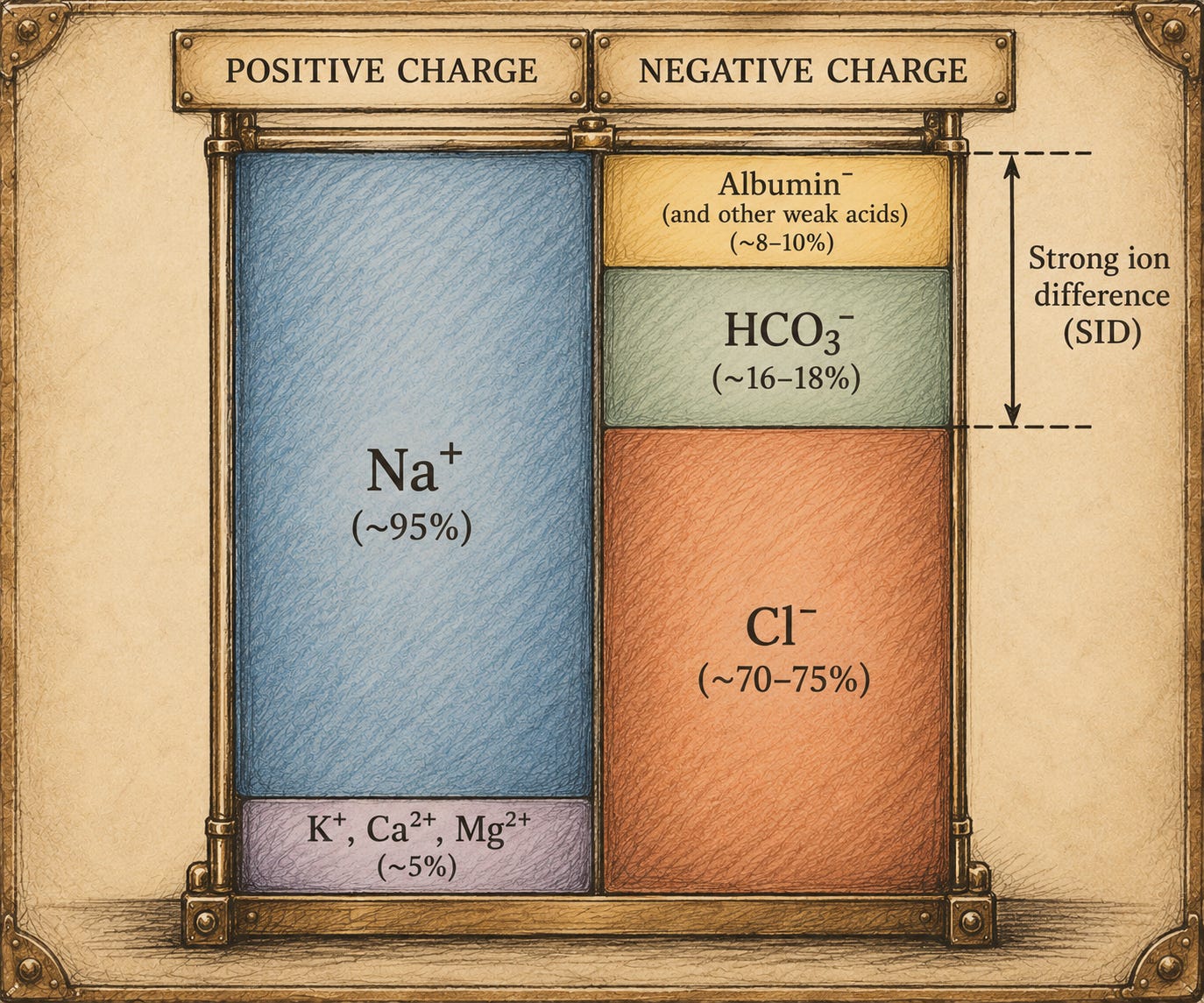
Now count the charge carried by the strong ions. The strong positive side includes sodium, potassium, calcium and magnesium. The strong negative side includes chloride, lactate and other strong anions. Suppose, purely for illustration, that the strong positive charges total:
145 mEq/L
and the strong negative charges total:
105 mEq/L
Subtract one from the other:
145 − 105 = 40 mEq/L
That difference is the strong ion difference, or SID.
Have we just discovered 40 mEq/L of unbalanced positive electrical charge floating around in plasma? No. We have only counted one group of charged substances.
Bicarbonate also carries negative charge. So do albumin and phosphate. Those account for most of the difference left when we count the strong ions alone.
Approximately:
SID ≈ bicarbonate negative charge + weak-acid negative charge
The SID is not an electrically empty gap. It represents strong positive charge that is balanced by negative charge elsewhere in the solution. The whole solution remains essentially electrically neutral. This is electroneutrality.
That is a physical constraint rather than something the body actively regulates. A large separation of charge in bulk fluid would generate enormous electrical forces.
SID counts charge, which is why it is properly expressed in equivalents. Na⁺ carries one positive charge, so 1 mmol of sodium contributes 1 mEq of positive charge. Ca²⁺ carries two, so 1 mmol of calcium ions contributes 2 mEq.
Sodium and chloride dominate the strong-ion concentrations, which makes Na−Cl useful at the bedside. But Na−Cl is not the complete SID. It leaves out potassium, calcium, magnesium, lactate and the other strong ions.
There is another scale worth remembering from Part 1. At pH 7.40, free H⁺ is only about:
40 nanomol/L or 0.00004 mmol/L
SID, bicarbonate and buffer charge are measured in tens of milliequivalents per litre.
So if SID differs by several mEq/L, that cannot be balanced by accumulating several mmol/L of free H⁺. The free H⁺ concentration is far too small. Most of the milliequivalent-scale differences in charge lie in bicarbonate and the other buffers. A tiny change in free H⁺ can still produce a substantial change in pH.
How does SID connect to H⁺?
This is where it is easy to accidentally invent a causal sequence. For the moment, do not imagine anything being infused or removed. Instead compare two solutions at equilibrium. Give them the same temperature, the same PCO₂, and the same total amount of albumin and phosphate per litre.
Suppose one solution has more free H⁺. What else must be different?