


It is a time of uneasy equilibrium. The phantom pressure has been challenged, but not defeated. A fixed volume of blood still stretches compliant vessels, storing energy and limiting the circulation’s possible states. Now a new defender has arisen, determined to restore the gradient and return the heart to its permissive role…
What survived the phantom
Episode IV dismantled a familiar explanation of venous return. Brengelmann showed that Guyton’s curve did not require a pressure source hidden within the veins. Mean systemic pressure (Pms) remained real, but as the equilibrium pressure of the systemic circulation after flow had stopped, not an anatomical pressure shown to drive blood towards the heart.
That left an important question unanswered. If Pms was not pushing blood home from somewhere inside the circulation, how did blood volume and vascular tone influence cardiac output?
Their influence was difficult to deny. Haemorrhage can reduce cardiac output even when the heart itself is healthy. Intravenous fluid or venoconstriction can alter cardiac filling and raise output without any primary change in contractility. Removing Pms as a driving pressure did not make the vascular system irrelevant. It created a need for a better explanation of what the vascular system contributed.
Brengelmann’s analysis could not provide that explanation on its own. The experiments he criticised used pumps that imposed flow and then measured how pressure and volume responded. They showed how a vascular system behaved when its flow had already been chosen, but not how a real heart and circulation arrived at their shared operating point.
Sheldon Magder offered an answer. He retained Guyton’s distinction between cardiac and return functions, but gave the elastic vascular reservoir a central role. In his account, the filled vasculature stored energy and recoiled, returning blood towards the heart. The heart lowered the pressure at its inlet to permit that return, then restored the blood to the arterial circulation.
The idea would find its most memorable expression in a bathtub.
The phantom may have gone, but the reservoir was about to take its place.
The elastic reservoir
At the centre of Magder’s argument lies a fact that no critique of Guyton can deny: filling an elastic vascular system changes its mechanical state. Blood volume distends vessel walls and produces pressure even after the heart has stopped. In the stressed and unstressed volume model discussed in Episode III, the stressed-volume term describes the part of the contained volume associated with that distension. Pms expresses the relationship between this volume and the combined compliance of the systemic vasculature.
The veins dominate that relationship. They contain most of the systemic blood volume because the venous system has a large resting vascular volume and is highly compliant. They can therefore accommodate substantial changes in volume over a relatively small pressure range. Venous smooth-muscle contraction changes the space available to contain blood; intravenous fluid changes the volume that must be contained. Both interventions can alter the systemic elastic state and therefore Pms.
Magder illustrates the energy stored in this state with a simple demonstration. Stop the circulation and open a large vein to atmospheric pressure. The distended vascular walls now have a route through which to release their stored elastic energy. As they recoil, blood flows through the opening even though the heart is no longer contracting. The vessels become progressively less distended, and flow slows until the pressure difference from atmosphere disappears or the vasculature approaches its resting configuration.
The experiment proves that the filled vasculature stores potential energy. It also reveals the limit of that energy. The discharge is finite. As blood leaves the system, vascular volume falls and the elastic pressure falls with it.
Magder carries this picture into the intact circulation. The veins and venules remain distended, so their elastic recoil becomes the upstream source for venous return. Right atrial pressure provides the downstream boundary. The heart keeps that boundary low enough to permit drainage, receives the returning blood and restores it to the arterial side.
It is an appealing division of labour: the reservoir returns the blood; the heart puts it back.
The permissive heart and the bathtub
Magder describes the heart as both permissive and restorative. By emptying its chambers, it lowers the pressure at its inlet and allows blood to enter from the systemic veins. It then returns that volume to the arterial circulation. Once a steady state is established, the amount restored each minute matches the amount returning.
The word permissive can sound as though the heart has been demoted to a passive bystander. That is not Magder’s claim. A failing heart can obstruct the return function and limit the flow achieved by the whole circulation. When filling or ejection is impaired, right atrial pressure rises and the operating cardiac output falls. Greater pump power, however, cannot sustain an output that the vascular system cannot accommodate. Once the heart has lowered its inlet pressure sufficiently, Magder places the remaining limit in the vascular reservoir and the path through which it drains.
He uses a bathtub analogy to explain this division of labour between the heart and vasculature.
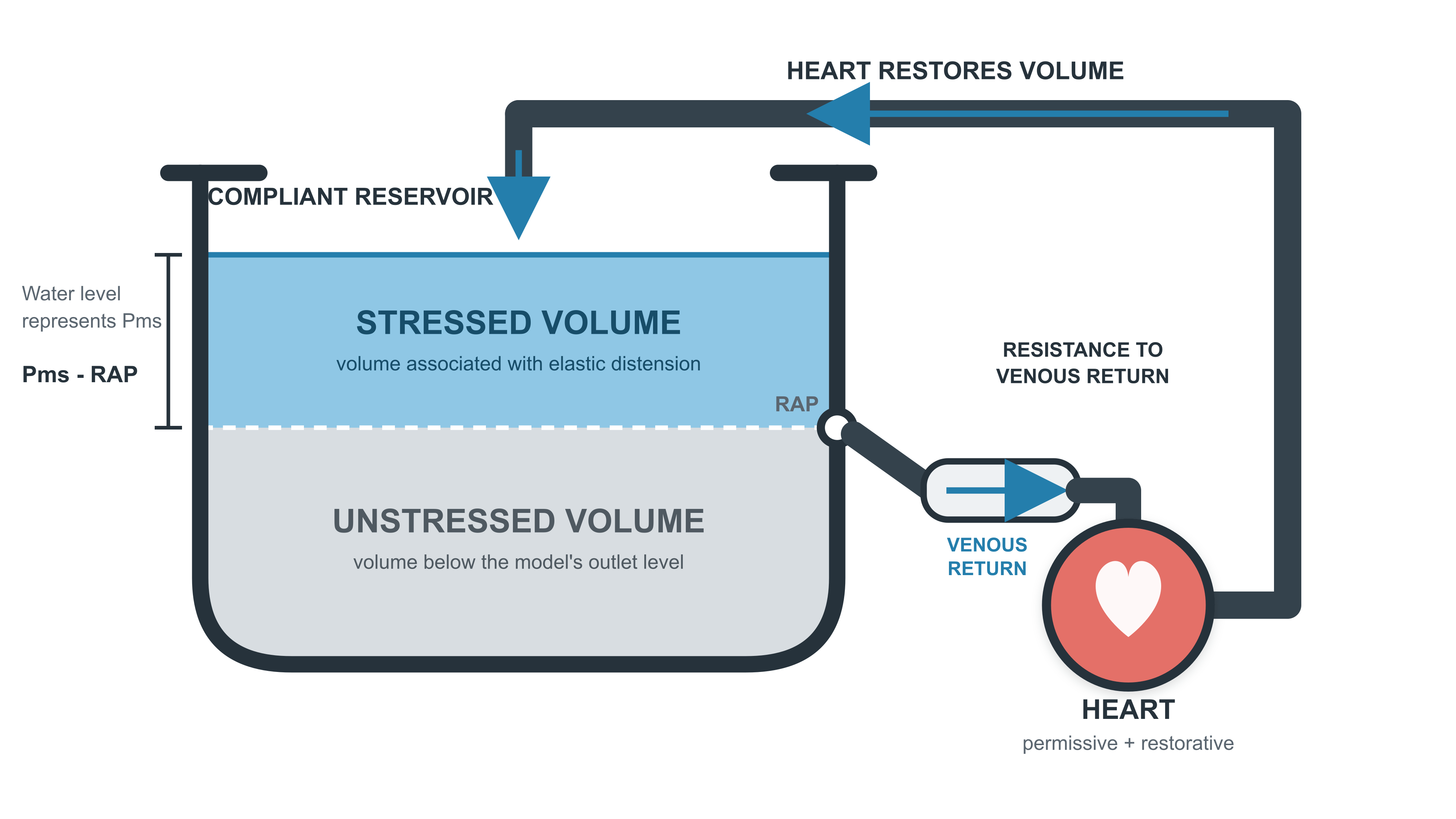
Water in the tub represents blood contained within the compliant venous system. Water below the level of the outlet represents unstressed volume, while the water above it represents the stressed component. The height of the water surface stands for the filling pressure of the reservoir. The outlet height stands for right atrial pressure. Their difference represents the pressure head across the drain, whose resistance represents resistance to venous return. Water leaving the drain is venous return; the tap is the heart, restoring that volume to the tub.
The model feels almost self-evident once drawn. Magder strengthens the comparison by pointing out that the heart contains little blood compared with the veins and venules. It cannot suddenly add enough volume to the venous reservoir to increase its elastic recoil pressure substantially. Like a tap filling a large bathtub, it can alter drainage only if inflow exceeds outflow for long enough to raise the water level. A more forceful jet therefore has no immediate effect on the drain; its effect appears only after sufficient volume has accumulated in the reservoir.
If inflow briefly exceeds outflow, the water level rises until drainage catches up. If the drain removes water faster than the tap supplies it, the level falls. At steady state the two flows are equal, yet the tub’s water level, outlet height and drainage resistance appear to decide what that common flow must be.
Several features of the circulation fit neatly into the picture. The amount of fluid matters, as does the size and elasticity of the space containing it. Venoconstriction resembles making the reservoir smaller: the same blood volume must then be accommodated within less space, increasing the vascular system’s elastic pressure. The heart must replace whatever leaves the venous side, and inflow and outflow must match when the circulation reaches equilibrium.
The analogy also offers a clear account of the plateau at the upper end of a venous return curve. When right atrial pressure falls sufficiently, the great veins begin to collapse where their internal pressure approaches the surrounding pressure. Further reductions in right atrial pressure then fail to increase flow. This is a genuine flow limit, although it explains the plateau at very low right atrial pressure rather than the ordinary sloping part of the curve.
I found the bathtub persuasive on first reading. Every part appears to have an obvious cardiovascular counterpart, and the whole model can be understood in seconds. That is a formidable advantage in physiology. It is also why the analogy deserves more than a superficial reading. But while a good picture can clarify a mechanism, it can also lend the mechanism physics that belong to the picture alone.
What Magder gets right
A fair reading of Magder should begin with the strength of his case. The vascular system is not scenery through which the heart happens to pump. It places real limits on the state that the heart can establish.
Increasing blood volume can strengthen the systemic elastic state by increasing the volume associated with vascular distension. Venoconstriction can produce a similar change without adding fluid because a smaller venous space must accommodate the same total blood volume. Both interventions can increase Pms and present a different filling state to the heart.
Neither intervention guarantees a higher cardiac output. A heart already operating near its filling or pumping limit may be unable to accept the altered vascular state. Venous and atrial pressures then rise, while flow changes little. The converse also applies. Increasing contractility may achieve little when the vascular system cannot support a different steady distribution of blood.
This preserves the deepest part of Guyton’s insight. Cardiac output belongs to neither the heart nor the vasculature alone. It emerges from their interaction. Magder is right to resist a pendulum swing from “the veins drive flow” to “only the heart matters”. The circulation contains one energy source, but many constraints.
Right atrial pressure therefore retains clinical meaning. A high value may accompany a heart that cannot transmit the volume presented to it, and it may alert us to an important cardiac constraint. Its value describes part of the resolved circulatory state. Whether it independently opposes the return of blood is a different question.
One reservoir becomes many
The single bathtub is useful because it is simple. The real circulation refuses to remain that simple.
Magder turns to the Krogh model, in which two vascular beds are arranged in parallel. The splanchnic circulation behaves as a large, highly compliant region that contains substantial volume and adjusts relatively slowly. Much of the muscular circulation has lower compliance and a shorter drainage time. The speed with which either region adjusts depends on both its compliance and the resistance through which it empties.
The comparison is no longer one bathtub. Imagine instead a deep, wide bath beside a smaller sink, both supplied in parallel. Direct more of the total flow through the bath and more of the fixed blood volume must reside there. Direct flow through the smaller, faster compartment and the same total volume can support a different overall throughput.
Regional arterial resistance helps determine how flow is divided between these beds. A greater share passing through the slow, compliant splanchnic region commits more blood to that region and reduces the total flow compatible with the fixed vascular volume. Redirecting blood towards a less compliant, faster region can permit a higher total flow without changing total blood volume or the zero-flow Pms.
The same Pms can therefore coexist with different steady flows. That observation does not invalidate the venous return equation, but it changes the meaning of its denominator. “Resistance to venous return” cannot be only the physical resistance of veins running from a Pms reservoir to the right atrium. It is an effective property of the entire network, shaped by regional arterial and venous resistances, compliance, flow distribution and the volume shifts that accompany them.
Magder’s more developed model is richer than the bathtub that introduced it. The elastic state constrains the range of possible flows; regional mechanics influence which flow the circulation reaches. Pms sets an important boundary without supplying a unique answer.
The contradiction and the hidden energy source
A tension runs through Magder’s writing that is easy to miss. His treatment of pressure shifts between a systems description, in which pressure and flow are determined together, and a causal description, in which particular pressures govern the resulting flow. This shift appears at several points in his argument.
The first involves right atrial pressure. Magder recognises that cardiac output, venous return and right atrial pressure are determined together through the interaction between cardiac and vascular function. Yet he also describes right atrial pressure as an independent back pressure opposing venous return. These are different accounts of the same variable. In one, right atrial pressure is part of the state reached by the circulation. In the other, it acts upon the circulation to determine that state.
Guyton had lived with the same contradiction. His 1955 paper stated that right atrial pressure was determined simultaneously with cardiac output, yet repeatedly described it as an opposing pressure. Magder inherits both versions, although the language of opposition carries more of the explanatory weight.
The second contradiction concerns Pms. It is defined as the common equilibrium pressure reached when flow stops and pressures equalise across the systemic circulation. During flow, however, Magder follows Rothe in locating an equivalent pressure within the venous circulation and treating it as the upstream pressure driving venous return. A local venous pressure during flow is a different physical variable. It changes with cardiac function, vascular resistance and the distribution of blood volume, and may lie above or below the zero-flow Pms even when total stressed volume remains unchanged. Numerical similarity does not turn a local pressure in the flowing circulation into the equilibrium pressure of the whole system.
The third contradiction becomes apparent when Magder compares the arterial and venous sides. He describes arterial pressure as a consequence of cardiac output interacting with resistance and arterial compliance. Yet venous pressures are granted a more causal role. Pms drives blood towards the heart, while right atrial pressure opposes it. The same systems logic should apply on both sides. Cardiac activity redistributes blood towards the arteries, raising arterial pressure while reducing venous volume and pressure. Both pressures emerge from the interaction between cardiac activity, vascular properties and the resulting distribution of blood.
The bathtub makes these inconsistencies difficult to see because it brings its own source of energy. Water at the surface possesses gravitational potential energy relative to the drain. Gravity continues to do work as the water descends, while the external supply feeding the tap restores the water to its elevated position. The circulation also stores energy in its distended vascular walls. Opening a vein to atmosphere releases some of it. A vascular compartment can surrender that stored energy, however, only while it recoils and loses volume. During steady flow its average volume and pressure remain constant because the blood leaving is replaced.
The reservoir clearly constrains the state that the circulation can achieve. Whether an unchanged reservoir can continuously supply the work that Magder assigns to it is a different question.
The reservoir has awakened. In the next episode, Brengelmann pulls the plug.
Continued in Episode VI: The Bathtub Menace.
Original papers
Magder S. Point: The classical Guyton view that mean systemic pressure, right atrial pressure, and venous resistance govern venous return is correct. Journal of Applied Physiology. 2006;101(5):1523–1525. https://doi.org/10.1152/japplphysiol.00698.2006
Magder S. Volume and its relationship to cardiac output and venous return. Critical Care. 2016;20:271. https://doi.org/10.1186/s13054-016-1438-7
Magder S, Slobod D, Vieillard-Baron A. Physiological and clinical significance of mean circulatory and mean systemic filling pressure. Annals of Intensive Care. 2025;15:187. https://doi.org/10.1186/s13613-025-01595-0