


Physiology papers often use terms such as stressed volume, unstressed volume, compliance, capacitance, vascular tone and mean systemic filling pressure within a few paragraphs of each other. They are closely related, but they describe different things.
Most explanations move through these concepts quickly. V₀ appears as an intercept, compliance as a slope, stressed volume as another variable, and before long they are being used in equations for mean systemic filling pressure and venous return. That is efficient if you already understand the underlying physics. If you do not, it is very easy to learn the terminology without ever building a clear picture of what the terms actually describe.
So I am going to take this slowly. We will build the ideas one at a time: what zero transmural pressure means, what V₀ represents, where stressed volume comes from, what compliance changes, and how these pieces combine to determine pressure and where volume resides.
These are not just definitions. Together they describe the physical state of the vascular system. That physics has to be clear before venous return, the Guyton equation, fluids or vasopressors can really make sense.
This first part will stay with that pressure–volume physics. The easiest place to begin is not with the circulation at all, but with a single elastic container.
Start with the pressure across the wall
Imagine an elastic container filled with fluid. What distends its wall is not simply the pressure inside it, but the difference between the pressure inside and the pressure outside. This is the transmural pressure:
Transmural pressure = pressure inside − pressure outside
If the pressure inside and outside are equal, transmural pressure is zero. That does not mean the container is empty. It may still contain a substantial volume of fluid.
Imagine, for example, that our container holds 700 mL when the pressure inside is exactly equal to the pressure outside. Its wall is not being distended by a pressure difference, but it is certainly not empty.
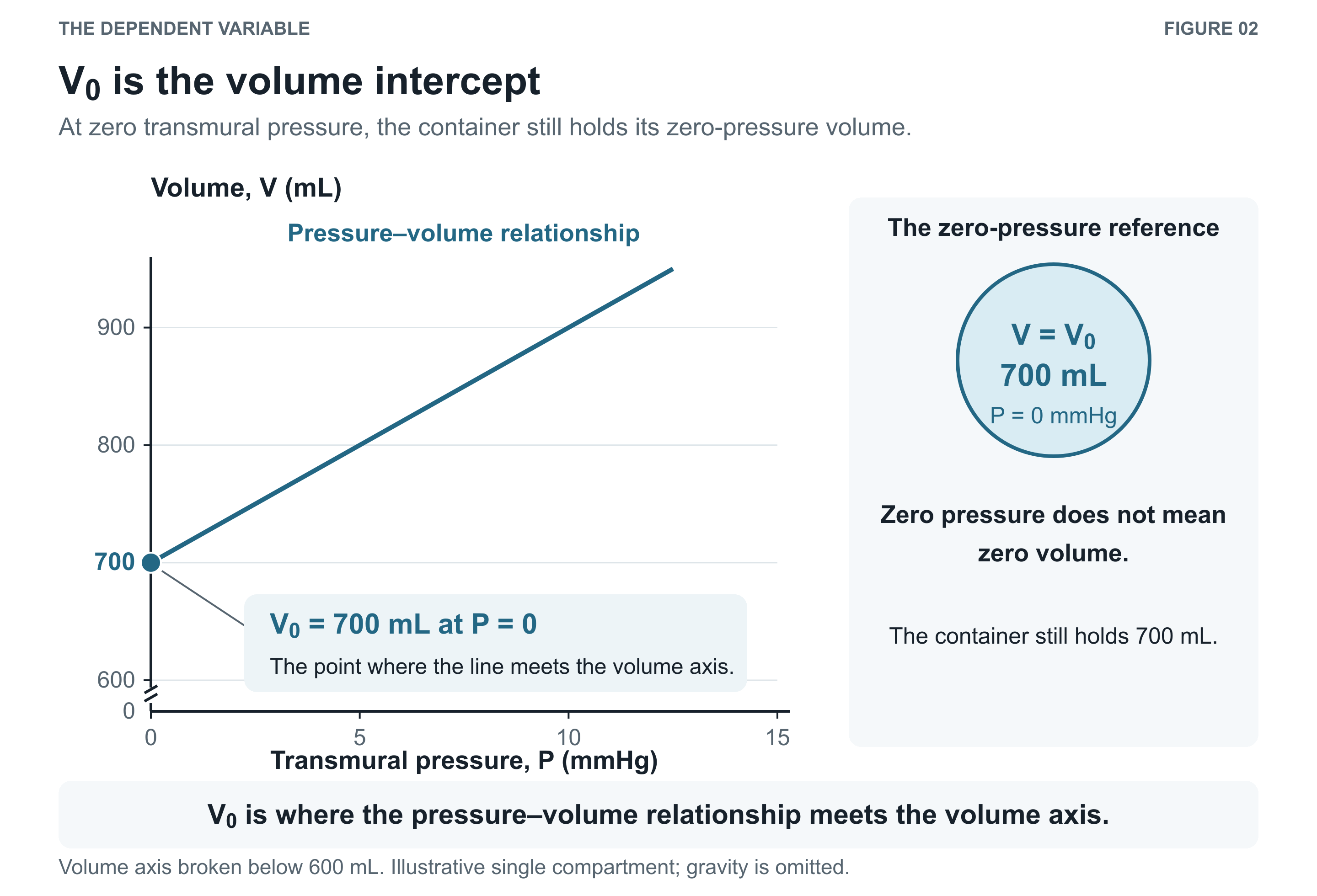
That 700 mL is its zero-pressure volume, or V₀. In the simple model we will use here, V₀ is the unstressed volume.
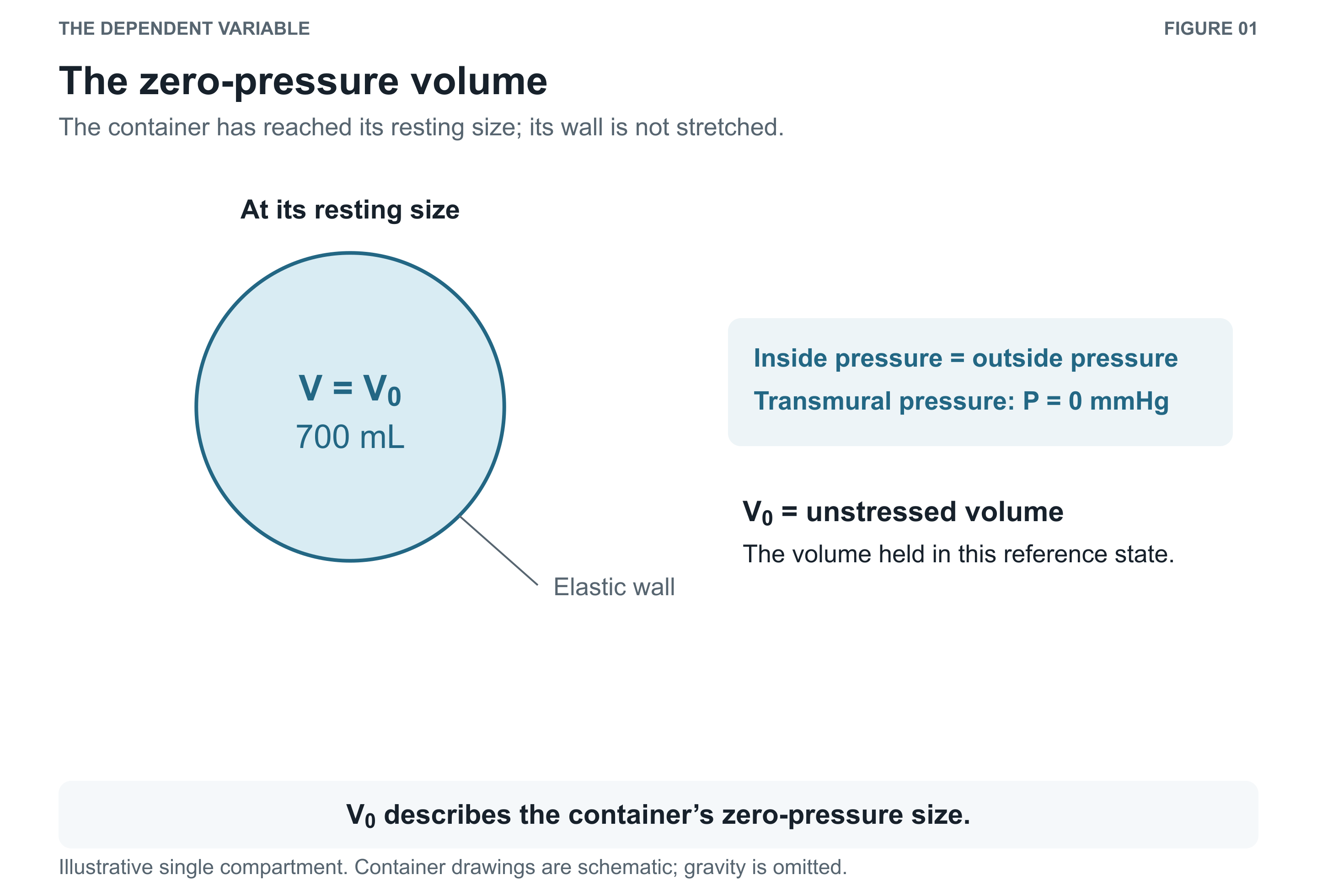
V₀ is easiest to think of as the size of the container at zero transmural pressure.
If we draw volume on the vertical axis and transmural pressure on the horizontal axis, V₀ is the point where the pressure–volume relationship crosses the volume axis. It is the intercept.
Now add some more volume
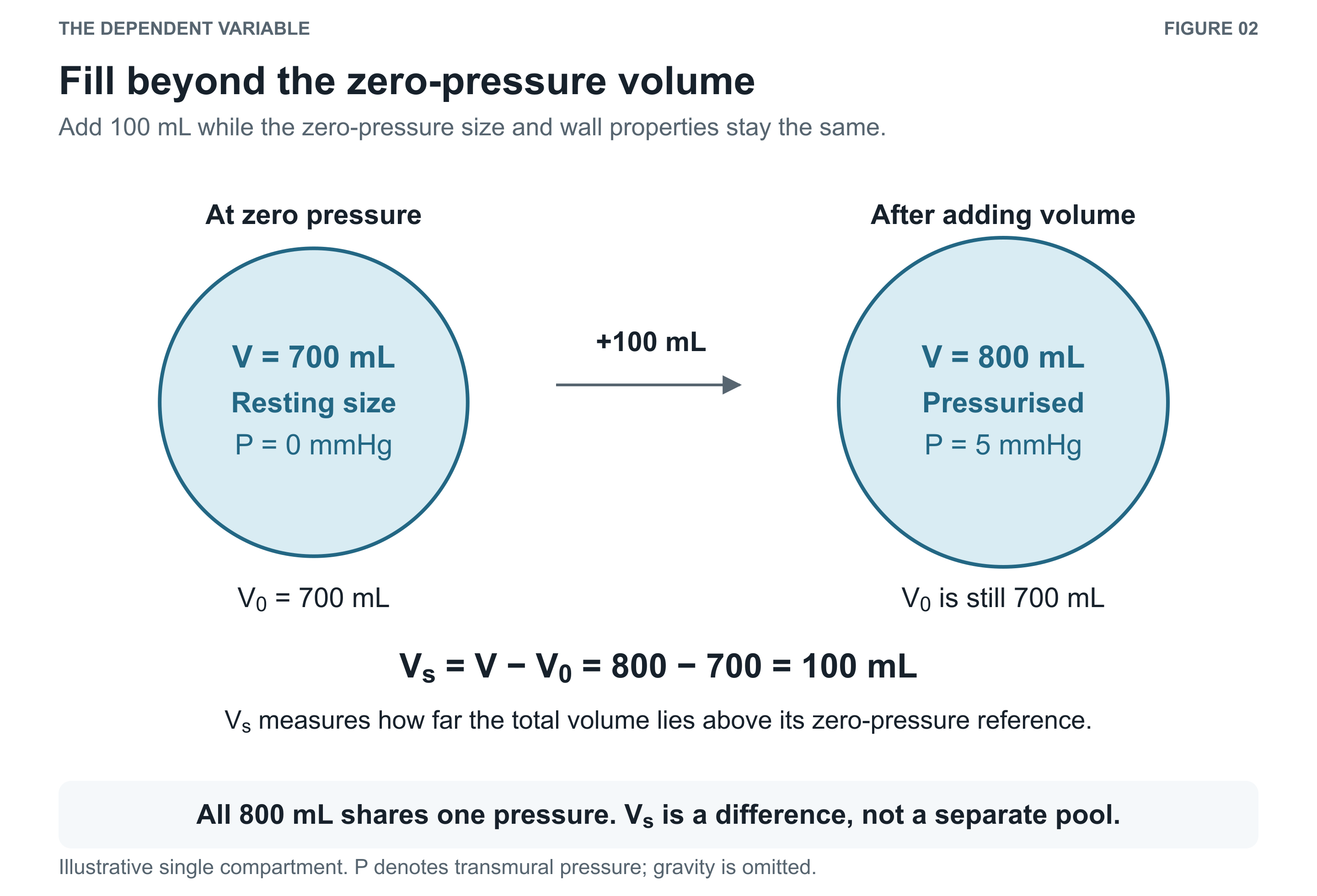
Suppose we add another 100 mL. The container now contains 800 mL, but its zero-pressure volume is still 700 mL. The additional 100 mL has expanded the container beyond its zero-pressure size.
That 100 mL is the stressed volume. So:
Vs = V − V₀
In this example:
Vs = 800 − 700 = 100 mL
The terminology can create an unfortunate mental picture. There are not 700 mL of “unstressed fluid” sitting in one part of the container and 100 mL of “stressed fluid” sitting somewhere else. All 800 mL is in the same container and all of it shares the same internal pressure.
Stressed and unstressed volume are accounting descriptions referenced to V₀. V₀ tells us how much the container holds at zero transmural pressure. Vs tells us how far the current volume lies above that reference.
Because our container is already filled beyond V₀, any further volume increases Vs immediately. There is no separate empty “unstressed compartment” that must first be filled before additional volume becomes stressed.
V₀ is the zero-pressure size
V₀ is not necessarily a fixed anatomical number. Make the zero-pressure container smaller and V₀ falls. Make it larger and V₀ rises.
Across the vasculature, smooth-muscle tone changes the zero-pressure size of the vascular compartment. Vasoconstriction reduces V₀ by making that zero-pressure container smaller. This effect is especially important in the venous circulation, where most of the blood volume is stored.
So V₀ is best understood as the volume a compartment would contain at zero transmural pressure in its current mechanical state.
That defines where the pressure–volume relationship starts. We now need to describe how the container behaves once it expands beyond that point.
Compliance tells us how easily the container expands
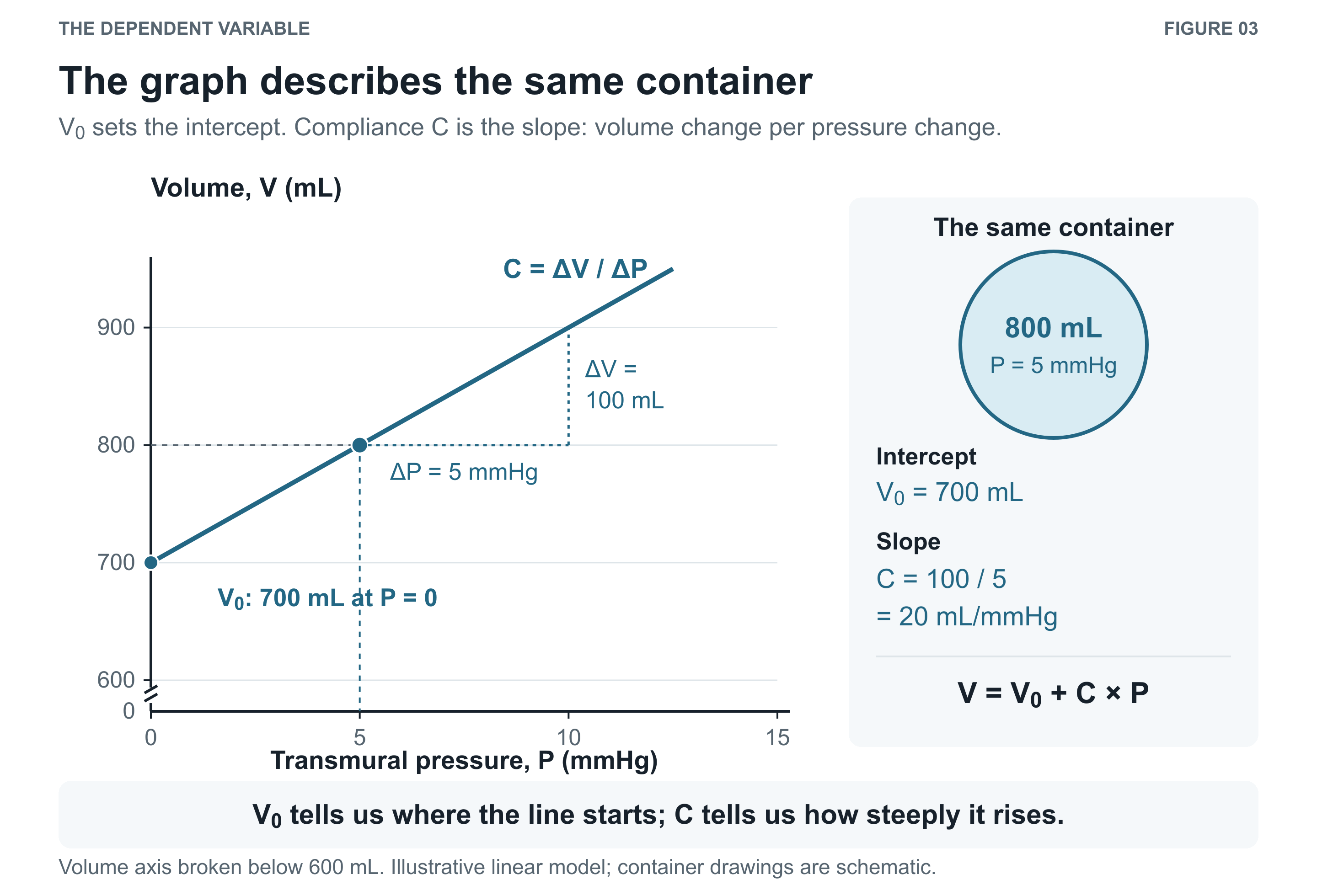
Once volume exceeds V₀, the container has been expanded beyond its zero-pressure size. How much extra volume the container can accommodate for a given change in pressure depends on its compliance. Compliance is defined as:
C = ΔV / ΔP
In words:
Compliance tells us how much the volume changes for a given change in pressure.
With volume on the vertical axis and pressure on the horizontal axis, compliance is the slope of the pressure–volume relationship. For now, assume that compliance remains constant as the container expands, giving us a straight-line pressure–volume relationship.
We can rearrange the equation:
ΔV = C × ΔP
Now start at V₀. At V₀, transmural pressure is zero. If the container is then filled beyond V₀ until the pressure reaches P, the change in pressure from the starting point is simply P. So:
ΔP = P
and therefore:
ΔV = C × P
What is ΔV here? It is the extra volume above V₀. So:
V − V₀ = C × P
The left side simply means:
total volume minus the zero-pressure volume
But that is exactly how we defined stressed volume:
Vs = V − V₀
So we can replace V − V₀ with Vs:
Vs = C × P
In words:
stressed volume is the amount of volume above V₀ corresponding to the pressure P, given the compliance of the container.
If we want to know the pressure instead, divide both sides by compliance:
P = Vs / C
In words:
Pressure depends on how much volume lies above V₀ and on how compliant the container is.
This is the key relationship. For the same stressed volume, a less compliant container will develop a higher pressure. For the same compliance, increasing stressed volume will increase pressure.
We can also write the whole pressure–volume relationship as:
V = V₀ + C × P
In words:
total volume = zero-pressure volume + the additional volume above V₀
So in the simple linear model:
V₀ sets the intercept. Compliance sets the slope. Together they define the pressure–volume relationship.
The same stressed volume can produce different pressures
Imagine two containers. Both contain 800 mL. Both have a V₀ of 700 mL. Both therefore have exactly the same stressed volume:
Vs = 100 mL
The only difference is that one container is less compliant than the other. The less compliant container develops a higher pressure.
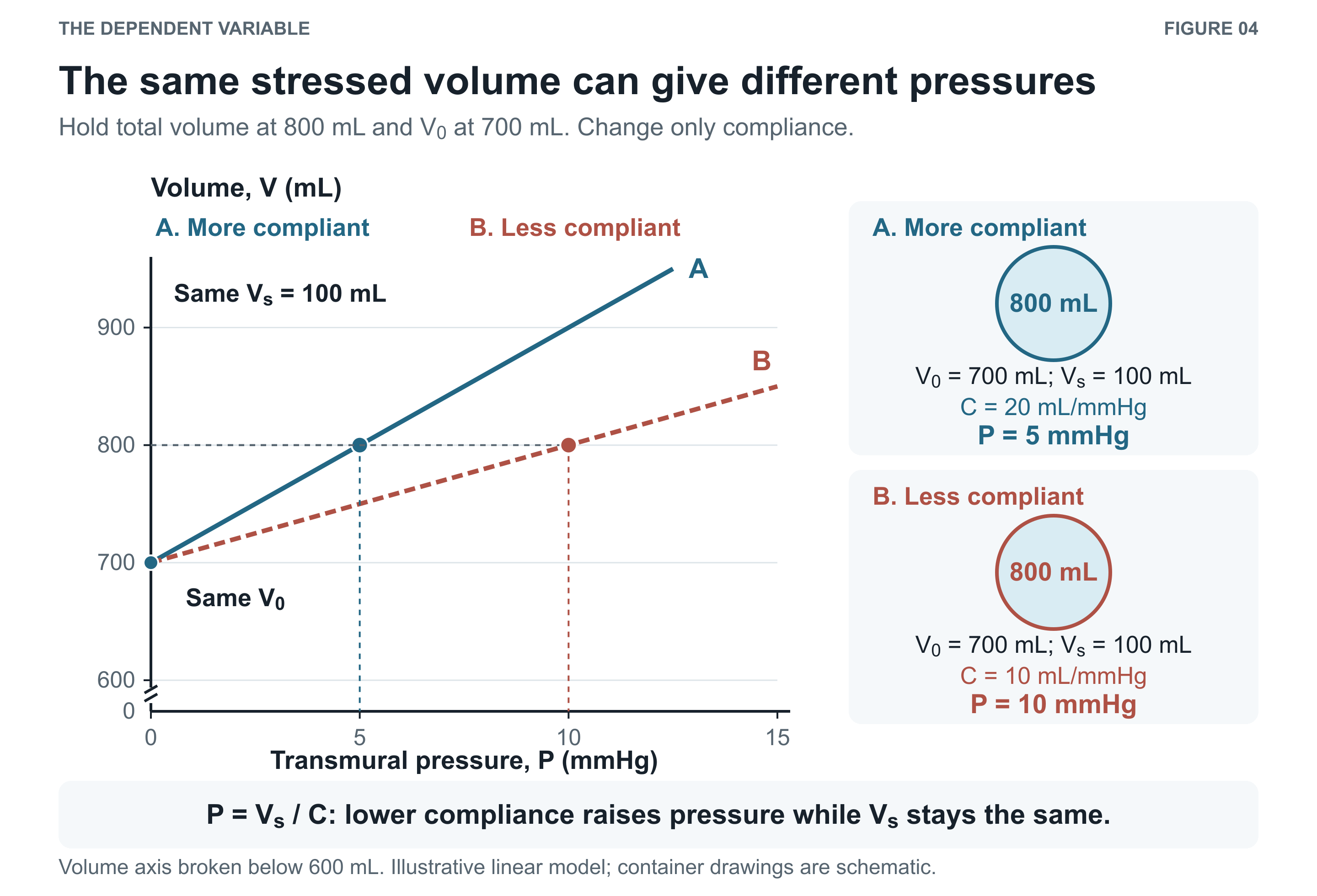
Nothing has happened to stressed volume. It remains 100 mL in both containers. Only compliance changed, yet pressure changed. The equation makes this explicit:
P = Vs / C
The same Vs divided by a smaller compliance gives a higher pressure. So a higher pressure does not necessarily mean there is more stressed volume.
The same total volume can produce more stressed volume
Now change something different. Keep total volume at 800 mL and keep compliance unchanged, but make the zero-pressure container smaller.
Suppose V₀ falls from 700 mL to 650 mL.
Before:
Vs = 800 − 700 = 100 mL
After:
Vs = 800 − 650 = 150 mL
No fluid was added. Total volume did not change.
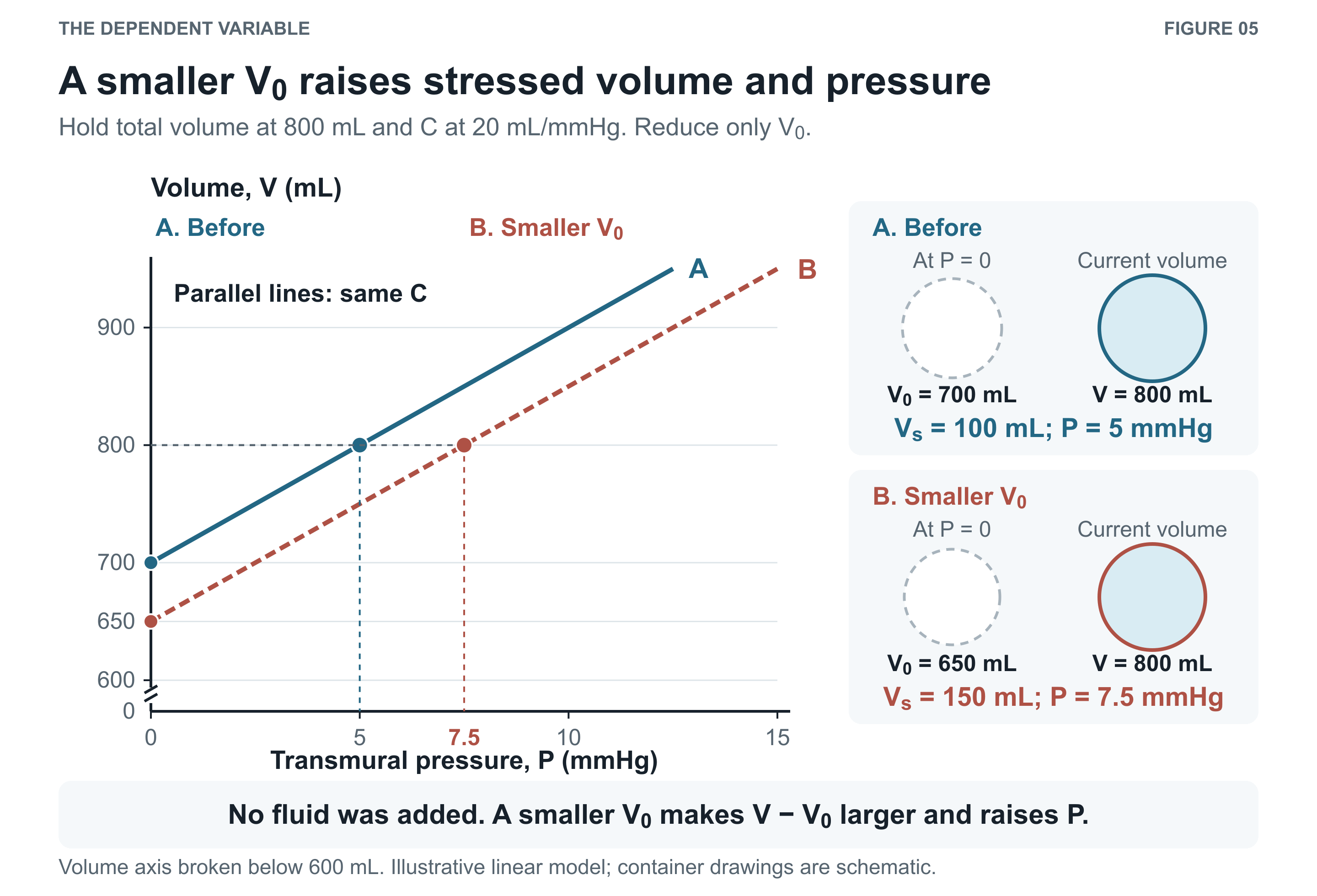
Stressed volume increased because the zero-pressure size of the container became smaller. Pressure rises as well.
This is the simplest way to understand how venoconstriction can increase stressed volume without adding blood.
It is sometimes described as conversion of unstressed volume into stressed volume. That works as bookkeeping, but it can sound as though blood has physically moved from one category into another.
The physical event is simpler. The pressure–volume relationship changed. The zero-pressure size of the container became smaller, so the same total volume now lies further above V₀.
Three different ways to raise pressure
We can now separate three quite different changes.
If total volume rises while V₀ and compliance remain unchanged, stressed volume rises and pressure rises.
If V₀ falls while total volume and compliance remain unchanged, stressed volume also rises and pressure again rises.
But if compliance falls while total volume and V₀ remain unchanged, pressure rises even though stressed volume does not change at all.
The same rise in pressure can therefore arise from different changes in the vascular system. Pressure alone does not tell us which one occurred.
The pressure–volume relationship is more than compliance
Vascular compliance is sometimes discussed as though it describes the entire relationship between volume and pressure. It does not.
In the simple linear model, two things are needed: the zero-pressure intercept, V₀, and the slope, compliance. A container with a large V₀ behaves differently from one with the same compliance but a smaller V₀. The slopes are identical, but the pressure produced at the same total volume is not.
Real vessels are more complicated because their pressure–volume relationships are not perfectly linear. Compliance then becomes the local slope of the curve rather than one fixed number describing the whole vessel.
A simple example is a rubber balloon. It is hard to start inflating because the wall is initially relatively stiff. Once it has begun to expand, it becomes easier to add more volume. As it becomes very full, the wall is stretched towards its limit and it becomes harder again. Its compliance therefore changes as it fills: low at the beginning, higher through the middle range, then lower again at high volume.
The lungs behave similarly. Compliance varies with lung volume because the slope of the pressure–volume curve changes as the lungs move from low volume, through their more compliant middle range, towards high-volume distension.
Blood vessels behave in the same general way. Their walls change shape and tension as they fill, so the amount of extra volume accommodated by a given rise in pressure depends on where they already sit on their pressure–volume curve. A vessel can therefore be relatively compliant over one pressure range and much less compliant over another.
So when we talk about the compliance of a real vessel, we are usually describing the slope of the pressure–volume curve at a particular operating point, not a single property that remains constant at every volume and pressure.
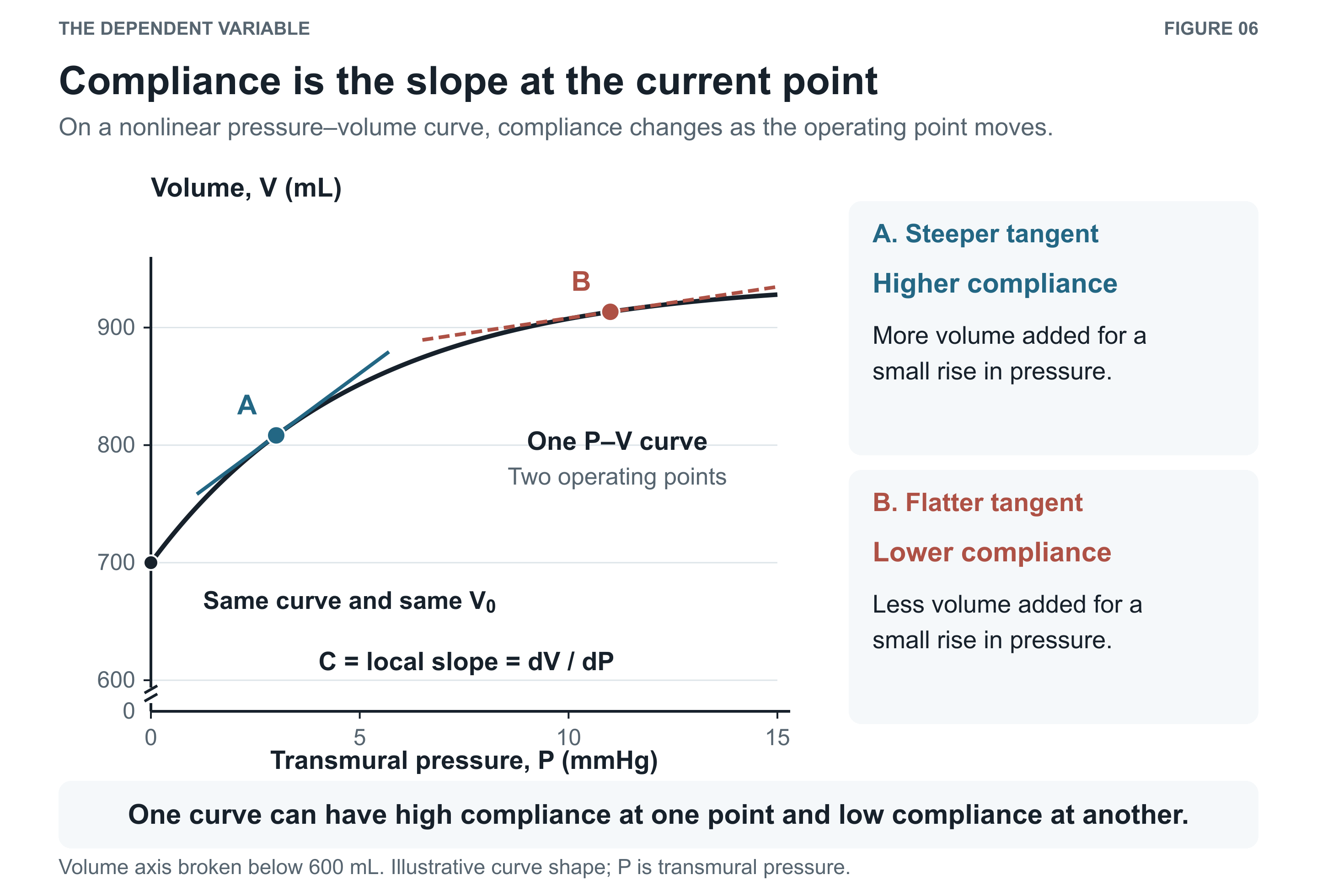
The complete pressure–volume relationship therefore contains more information than compliance alone. It includes the zero-pressure intercept, the changing slope and the curvature of the whole relationship.
Compliance and capacitance are not the same thing
The word capacitance is used inconsistently in the physiological literature and is sometimes treated almost as a synonym for compliance. They are different.
Compliance describes the change in volume for a change in pressure.
Capacitance describes the volume accommodated at a specified pressure. I will use the term in that sense here.
Consider two containers with the same compliance. Their pressure–volume lines therefore have the same slope. But if one has a larger V₀ than the other, it will contain more volume at any given pressure.
Its capacitance is greater even though its compliance is identical. So, for the simple linear relationship we have been using:
Compliance describes the slope of the pressure–volume relationship.
Capacitance describes the volume contained at a chosen pressure. It therefore depends on both the slope and V₀.
A capacitance value describes one point on the pressure–volume relationship, not the whole relationship.
What does venous tone do?
Venous tone is another term that is often used almost interchangeably with stressed volume or capacitance. It should not be.
Tone is a mechanism that changes the mechanical state of the venous wall. Increasing smooth-muscle tone can reduce the zero-pressure size of a vessel and therefore reduce V₀. If total blood volume remains unchanged, stressed volume then rises.
Tone may also alter compliance and the curvature of the pressure–volume relationship. These effects need not occur together.
A change in tone may alter V₀, compliance, or both.
The most useful description of venoconstriction is therefore not simply that it “raises stressed volume”. It changes the venous pressure–volume relationship. Stressed volume may rise because V₀ falls, but pressure may also change because compliance changes.
Real veins are not one balloon
The single-container model is useful because it lets us change one variable at a time.
The real circulation contains many connected vascular compartments. They have different zero-pressure volumes, different compliances, nonlinear pressure–volume relationships and different surrounding pressures. Their smooth-muscle tone can change independently, and blood can redistribute between them.
So although an isolated-container experiment can show what would happen if compliance changed at a fixed volume, a connected circulation does not generally leave that volume fixed. If the mechanical properties of one region change, blood can move into or out of it until the whole system reaches a new state.
The simple container is not intended to reproduce the entire circulation. It gives us the language needed to understand what the circulation is doing.
The pressure–volume relationship also determines where blood resides
The pressure–volume relationship does more than determine what pressure results from a particular volume. In a connected circulation, it also helps determine how the total blood volume is distributed.
Imagine two vascular compartments connected together and exposed to the same surrounding pressure. With no flow between them, their intravascular pressures eventually equalise. Their transmural pressures are therefore also equal.
But equal pressure does not mean equal volume.
A compartment with a large V₀ can contain a large volume before any positive transmural pressure develops. If it is also highly compliant, it can accommodate still more volume for relatively little additional pressure. A smaller, less compliant compartment will contain much less blood at that same pressure.
In the linear model:
Vi = V₀i + Ci × P
Here:
Vi is the volume in a particular vascular compartment.
V₀i is that compartment’s zero-pressure volume.
Ci is its compliance.
P is the common transmural pressure.
In words:
The volume in each compartment equals its zero-pressure volume plus the extra volume it accommodates because it is distended above zero pressure.
That extra volume depends on two things: how compliant the compartment is and the pressure acting across its wall.
At a common pressure, a compartment with a larger V₀ starts with a larger zero-pressure volume, and a more compliant compartment accommodates more additional volume above that. Its final volume is therefore determined by both its V₀ and its compliance.
This is one reason so much of the blood in the circulation resides in the venous system. Veins have a large zero-pressure capacity and can accommodate large changes in volume for comparatively small changes in pressure.
At no-flow equilibrium, when arterial and venous pressures have equalised at mean systemic filling pressure, even more of the blood resides on the venous side than during normal flow.
When the heart pumps, it transfers some of that volume from the venous circulation into the arterial circulation. Arterial volume rises and venous volume falls. Because the arterial system is much less compliant, a relatively small increase in arterial volume produces a large increase in arterial pressure.
The pressure difference of the flowing circulation therefore reflects a different distribution of blood across the arterial and venous pressure–volume relationships. The heart redistributes volume; the pressures emerge from where that volume sits on those relationships.
External pressure belongs in the same picture
Vascular compartments do not exist in a vacuum. Their behaviour depends not only on the pressure inside them, but also on the pressure around them.
If a vascular compartment were completely closed and its volume could not change, increasing the external pressure would increase the pressure inside it. Transmural pressure might therefore change very little.
The circulation is different because its compartments are connected. If external pressure compresses one vascular region, blood can be displaced into another. Its volume falls and the blood redistributes until a new pressure–volume state is reached. An example is pneumoperitoneum for laparoscopic surgery, which can compress the abdominal venous reservoir and shift blood centrally, sometimes increasing venous return; with greater compression, it can instead impede venous flow.
External pressure can therefore change where blood resides by compressing and deforming a vascular compartment, altering its effective geometry and zero-pressure size and displacing blood elsewhere. It also changes the relationship between local vascular volume and pressure.
So surrounding pressure is another part of the mechanical environment that helps determine the vascular pressure–volume state.
The pressure–volume state
We can now put these ideas together.
The systemic vascular pressure–volume state describes the relationship between the blood within the circulation and the mechanical properties of the vascular system containing it.
It is determined by total blood volume and by the pressure–volume properties of the vascular compartments: their V₀ values, compliances and curve shapes, geometry, tone and surrounding pressures.
At equilibrium, those properties determine how the blood is distributed and what pressure results. During flow, cardiac pumping changes that distribution, while the local pressure–volume relationships determine the pressures associated with the resulting volumes.
Two circulations can therefore contain the same total blood volume and have very different pressures because their pressure–volume states differ.
This is why “volume status” is such a limited description of the circulation. Volume is only one part of the state.
Where mean systemic filling pressure fits
Mean systemic filling pressure, Pms, is often discussed alongside stressed volume, sometimes almost as though one were a proxy for the other. They are closely related, but they are not interchangeable. We have already seen this in our single container:
P = Vs / C
In words:
Pressure depends on how much volume lies above V₀ and on how compliant the container is.
The same basic idea can be extended to the whole systemic circulation at no-flow equilibrium. For this simplified model, assume that the vascular compartments are exposed to the same surrounding pressure, which we take as zero, and ignore the effects of gravity. To keep the maths simple, imagine that all the vascular compartments have linear pressure–volume relationships. We can then treat them together as one combined system.
Let:
V₀,total = the combined zero-pressure volume of all the vascular compartments
and:
Ctotal = their combined compliance
The total blood volume can then be written as:
Vtotal = V₀,total + Ctotal × Pms
In words:
Total blood volume consists of the volume the vascular system could accommodate at zero transmural pressure, plus the additional volume held above that level.
In our simple linear model, that additional volume above V₀ is related to the pressure by compliance:
additional volume = compliance × pressure
So for the whole systemic circulation:
volume above V₀,total = Ctotal × Pms
Now subtract the combined zero-pressure volume from the total blood volume:
Vtotal − V₀,total = Ctotal × Pms
The left-hand side is simply the total volume sitting above V₀. But that is exactly what we mean by total stressed volume:
Vs,total = Vtotal − V₀,total
So we can write:
Vs,total = Ctotal × Pms
In words:
Total stressed volume is the amount of volume sitting above the combined zero-pressure volume of the systemic circulation. Its relationship with Pms depends on the compliance of that circulation.
Finally, if we want to express Pms rather than stressed volume, divide both sides by compliance:
Pms = Vs,total / Ctotal
In words:
Pms depends on both stressed volume and systemic vascular compliance.
This last step is the important one. If compliance stays unchanged, increasing stressed volume raises Pms. That makes it tempting to think of Pms as simply the pressure signature of stressed volume.
But suppose total blood volume and V₀,total stay exactly the same. Stressed volume is therefore unchanged.
Now reduce systemic vascular compliance.
The same stressed volume is being accommodated by a less compliant vascular system, so Pms rises. Nothing has happened to total stressed volume.
This is exactly the same phenomenon we saw with our original elastic container: the same Vs can produce different pressures if compliance changes.
In the real circulation, of course, the vascular system consists of connected compartments with nonlinear pressure–volume relationships, and blood redistributes as those relationships change. The simple equation is therefore a teaching model rather than a complete description of the circulation. But the conclusion survives:
Pms is better understood as the pressure signature of the systemic vascular pressure–volume state, not the pressure signature of stressed volume alone.
A higher Pms could reflect an increase in stressed volume. That might happen because blood volume was added or because venoconstriction reduced V₀. But Pms could also rise because vascular compliance fell while total stressed volume remained unchanged, or because several parts of the pressure–volume state changed together.
A higher Pms therefore does not, by itself, demonstrate that stressed volume has increased. It tells us that the equilibrium pressure produced by the systemic vascular pressure–volume state is higher.
Pulling the terms apart
The vocabulary becomes much easier once each term is assigned to the thing it actually describes.
Total blood volume is how much blood is present.
V₀, or unstressed volume, is the volume accommodated at zero transmural pressure.
Stressed volume is the amount by which the current volume exceeds V₀.
Compliance describes the change in volume for a change in pressure.
Capacitance describes the volume accommodated at a specified pressure.
Tone is one mechanism that can alter vascular size and the pressure–volume relationship.
The pressure–volume relationship is defined by the zero-pressure intercept and by how volume changes as pressure rises.
The pressure–volume state describes the current combination of blood volume, vascular geometry, mechanical properties and blood distribution that determines vascular pressures.
Mean systemic filling pressure is the equilibrium pressure reached throughout the systemic circulation when flow stops. It is the pressure signature of the systemic vascular pressure–volume state.
Taken together, these terms describe the vascular pressure–volume state: the relationship between the blood in the circulation and the vascular system containing it. That state determines how blood is accommodated and distributed, and what pressures result.
This also makes several common clinical claims easier to examine. A higher vascular pressure does not necessarily mean more stressed volume. Venoconstriction can increase stressed volume without adding blood. A fall in vascular compliance can raise Pms without changing stressed volume at all. Pms is therefore best understood as the equilibrium pressure produced by the whole systemic pressure–volume state, not as a direct measure of any one of its components.
That gives us the physical foundation. We now know what the upstream vascular state is and why Pms is a pressure produced by that state rather than a synonym for stressed volume.
The next question is what happens when the circulation is flowing. How does this vascular state interact with the heart? What does right atrial pressure actually represent? And if Pms is not simply a pressure pushing blood back to the heart, what should we make of the Guyton venous return equation?
That is Part 2.