


Part 1 stayed deliberately with the static circulation. We started with a simple elastic container and built up the ideas of V₀, stressed volume, compliance, capacitance and mean systemic filling pressure, Pms. The aim was to understand the physical state of the vascular system before trying to explain flow through it.
Now we can turn the pump on.
The key question is not simply what pressure exists in the circulation, but where the blood resides once the heart starts moving it around.
That will take us from the Guyton venous return curve to a rather different way of thinking about what Pms and RAP actually represent. We will also see why vasoconstriction and fluid can both increase systemic delivery, despite changing the pressure–volume state in very different ways.
Start with no flow
Imagine the systemic circulation with the heart stopped.
For the moment, keep the model simple. Ignore gravity and assume the vascular compartments are exposed to the same surrounding pressure.
With no flow, arterial and venous pressures eventually equalise at mean systemic filling pressure, Pms. So:
Pa = Pv = RAP = Pms
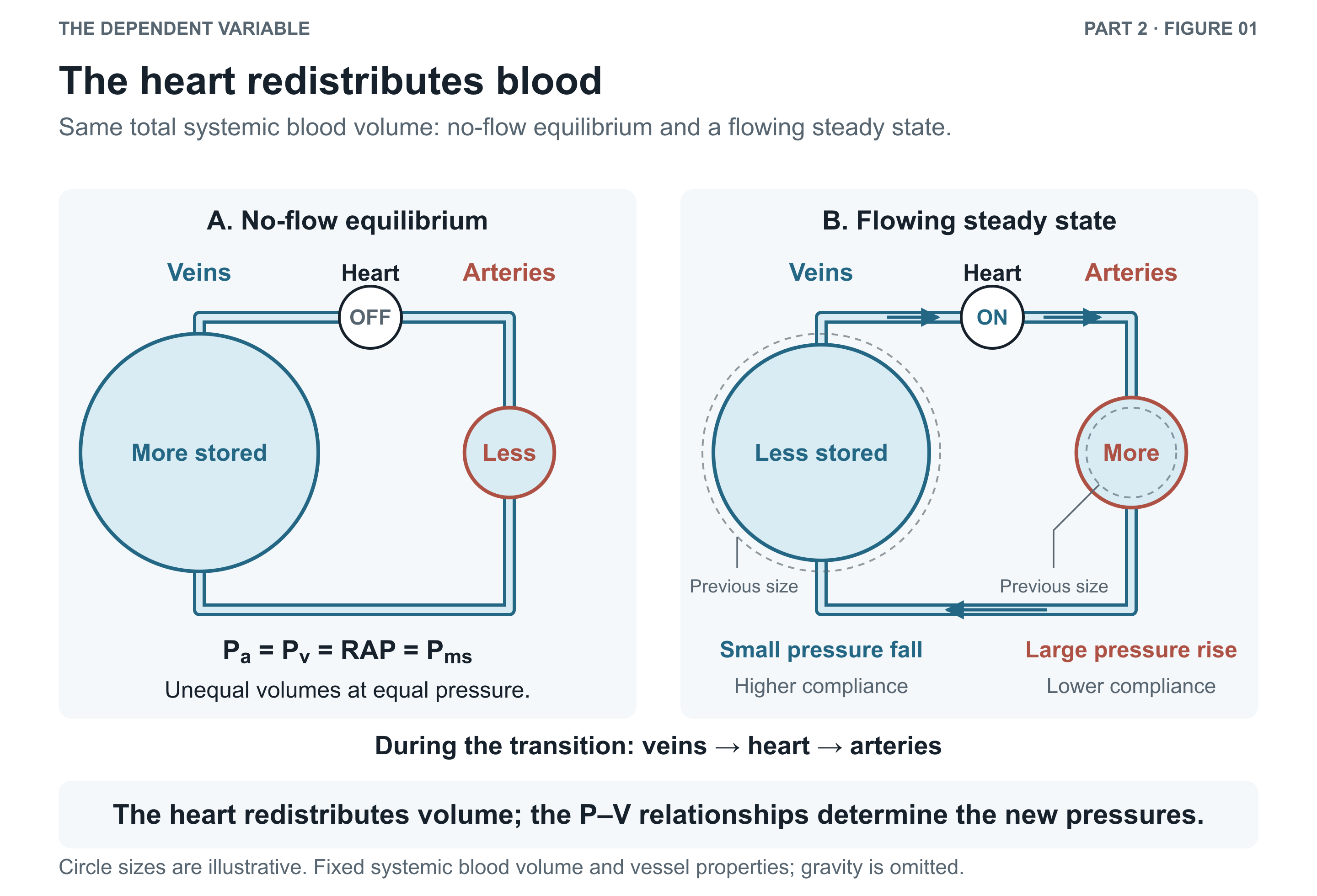
The pressures may be equal but that does not mean arterial and venous volumes are equal.
The arterial and venous compartments have very different pressure–volume relationships. The venous circulation has a much larger zero-pressure volume and is far more compliant, so most of the blood resides there even though the pressures are the same.
The P–V relationships determine where the blood resides even when every compartment shares the same pressure.
Pms tells us the equilibrium pressure of that no-flow state. It does not tell us that the blood is evenly distributed.
Turn the heart on
Now let the heart start pumping. The first thing it does is move volume from the venous side to the arterial side:
veins → heart → arteries
Venous volume falls. Arterial volume rises.
Those two compartments therefore move to new points on their own pressure–volume relationships.
Because the arterial circulation is poorly compliant, a relatively small increase in arterial volume produces a large rise in arterial pressure. The venous circulation is much more compliant, so a similar change in volume produces a much smaller pressure change there. The important causal sequence is:
The heart redistributes volume. The pressures change because those new volumes now sit at different points on the arterial and venous pressure–volume relationships.
The heart does not first create a high arterial pressure and then fill the arteries. It transfers volume into the arterial circulation, and the arterial P–V relationship determines the pressure that results.
Likewise, the fall in venous volume moves the venous circulation to a lower-pressure operating point.
The flowing circulation therefore has a different distribution of blood from the no-flow circulation.
Pressures separate around Pms
At no flow:
Pa = RAP = Pms
Once the heart is pumping, the arterial and venous pressures move away from that equilibrium value. Arterial pressure rises above Pms. Right atrial pressure falls below Pms. The actual pressure difference across the flowing systemic circulation is:
Pa − RAP = Q × Rt
where Q is systemic blood flow and Rt is total systemic vascular resistance.
Pa and RAP are real pressures at identifiable locations in the flowing circulation. The heart supplies the energy, and blood loses mechanical energy as it passes through the systemic resistance.
Pms is different. It is the equilibrium pressure the systemic circulation would reach if flow stopped.
So the flowing circulation can be pictured as two pressures separating around the no-flow reference:
Pa above Pms. RAP below Pms
Before looking at the equations describing those two sides, there is an apparent contradiction to resolve.
Pressure–volume and resistance describe the same state
We have seen that vascular pressure results from where blood volume sits on the pressure–volume relationship. Yet as we have just seen we can also write:
Pa − RAP = Q × Rt
which seems to relate the pressure difference to flow and resistance. Both are true.
The pressure–volume relationship tells us what pressure corresponds to the volume stored in each compliant vascular compartment.
The resistance relationship tells us how the difference between those pressures relates to flow.
In a steady circulation, both describe the same operating state and both have to be satisfied at the same time.
If flow, resistance or vascular properties change, the distribution of blood changes. The compartments move to new points on their pressure–volume relationships, producing a new set of pressures consistent with the flow and resistance of that state.
Resistance therefore does not generate pressure independently of volume. Nor does the pressure–volume relationship replace resistance. The same circulation has to satisfy both relationships.
With that in mind, we can look at Guyton’s venous return relationship.
The Guyton relationship
Guyton examined a series of different steady states at different imposed flows.
Plot flow on the vertical axis and RAP on the horizontal axis and the points form the familiar descending venous return line.
At zero flow, RAP reaches Pms. Pms is the zero-flow intercept.
As flow increases, RAP falls progressively below that zero-flow value.
For the moment, let us call the term relating the change in flow to the change in RAP Kv. The relationship can then be written:
RAP = Pms − Q × Kv
In words: RAP equals the no-flow equilibrium pressure, Pms, minus the amount by which RAP lies below that pressure at the given flow.
At zero flow:
Q = 0
so:
RAP = Pms
As flow increases, RAP moves further below Pms. Rearranging the same relationship gives:
Q = (Pms − RAP) / Kv
In words: flow is related to how far RAP lies below the no-flow reference pressure, with Kv describing how much that pressure difference changes with flow.
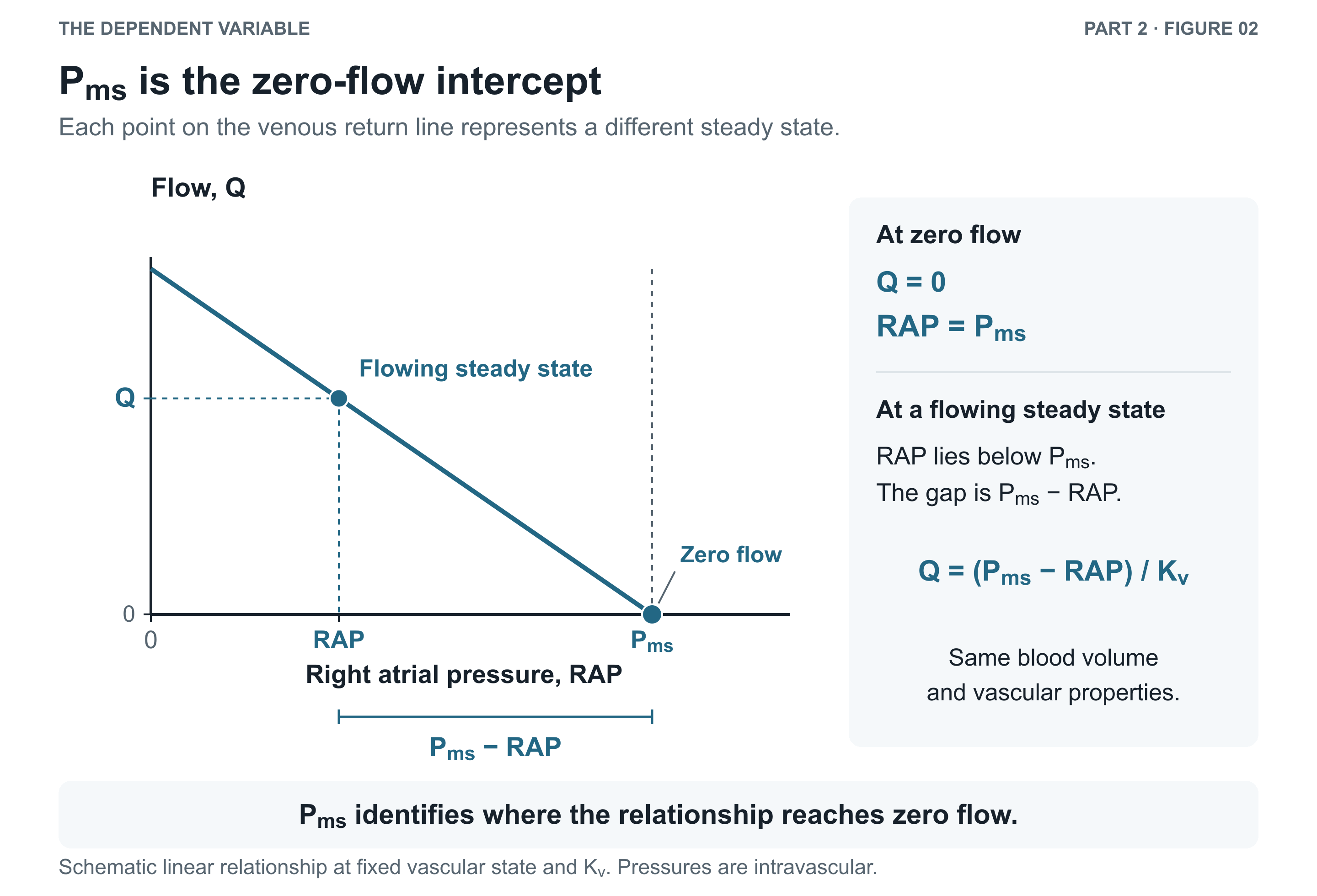
The graph is often read in the opposite direction: lower RAP and venous return increases.
But each point represents a different steady state of the vascular system. In Guyton’s experiments, flow was changed and RAP changed as part of the resulting redistribution of blood. The equation contains no arrow telling us that Pms pushes blood towards RAP. It simply describes how far RAP lies below its zero-flow reference pressure at each flow.
The arterial counterpart
Now write exactly the same type of relationship from the arterial side. As flow increases, arterial pressure rises above Pms. Call the corresponding term Ka. Then:
Pa = Pms + Q × Ka
In words: arterial pressure, Pa, equals the no-flow equilibrium pressure, Pms, plus the amount by which Pa lies above that pressure at the given flow.
or, rearranged:
Q = (Pa − Pms) / Ka
In words: flow is related to how far Pa lies above the no-flow reference pressure, with Ka describing how much that pressure difference changes with flow.
The two relationships now have the same form.
On the venous side:
Q = (Pms − RAP) / Kv
On the arterial side:
Q = (Pa − Pms) / Ka
If those equations are read causally, they make opposite claims about Pms. On the venous side, increasing Pms appears to increase flow; on the arterial side, increasing Pms appears to reduce it.
Both equations describe the same circulation, so Pms cannot simultaneously be a pressure driving flow and a back pressure opposing it.
Clearly that is not the mechanism. The same causal mistake appears in some discussions of tissue perfusion pressure (TPP), where an algebraic pressure difference is treated as though it were itself the mechanism of flow. I will come back to that in a future article.